Showing posts with label graph. Show all posts

Saturday, June 27, 2026

A Tale of Two Sidneys

Sidney was a common boys’ name for those born in the early 20th century and was among the first surnames to become widely used as given names, along with Stuart, Stanley, and Leslie. Its historical popularity for men has been attributed to the admiration of Algernon Sidney (1623-1683) who was an English aristocrat executed by the British Crown. He had such treasonous ideas as people have the right to choose their own government and people should retain the power to abolish it if it becomes corrupt. His writings were admired by the American founding fathers.

The Sydney spelling trended for girls in the 1990s. The popularity for women doesn’t have a clear inspiration, but it started gradually in 1983, accelerated in 1990 and 1994, and peaked for those born in 2000. It may have come to public attention due to Sydney Biddle Barrows, the Mayflower Madam, who became famous in the 1980s for running an exclusive New York brothel. She appeared on Saturday Night Live and had a tv movie made about her life. Notable film Sidneys were also played by Vanity (Action Jackson), Meg Ryan (D.O.A), Annette Bening (The American President) and Neve Campbell (Scream).

Sidney is one of those names people complain about becoming too feminine for boys to use anymore. Despite its more recent feminine shift, it does still have a reputation for being unisex. Hockey star Sidney Crosby is a famous association and there’s still the enduring fame of actor Sidney Poitier. Poitier himself named his daughter Sydney in 1973 before the popular trend for women.

In truth, Sidney has never been exclusively masculine. The evidence shows not one name that became feminine, but two overlapping traditions: a masculine surname style name that rose through political and literary admiration, and a female line of Sidney/Sydney with older roots beginning in Wales.

A 19th century unisex name

When Sidney was trending for men in the UK and North America in the first half of the 20th century, there was already a noticeable portion of women named Sidney. Sidney shows up in the Top 1000 US names for girls in the 1900s, with a small uptick in 1934 when the Australian Sydney Harbour bridge made world news. Further back, the 1850 US census has about 10,000 people named Sidney or Sydney, about 2,500 being female. This wasn’t just an American phenomenon. The 1851 England and Wales census lists about 5,000 people named Sidney or Sydney, including about 600 women and girls. Although women made up a smaller part, Sidney was not exclusively masculine.

This mixed usage was noted by contemporary name enthusiast Charlotte Yonge. She wrote in her 1863 History of Christian Names that Sidney was one of the first surnames used as a Christian name to come into use after the Reformation, and notes its use for women and men. She says for English boys it was inspired by the poet Sir Philip Sidney, but in Ireland Sidney was a girl’s name given in admiration of Philip’s father Sir Henry Sidney, Lord Deputy of Ireland.

Yonge wouldn’t have had to comb parish records to know of Irish women named Sydney. She would have known of Lady Sydney Morgan, the Irish novelist behind The Wild Irish Girl (1806), who was named after her grandmother in 1778. There was also Frances Sheridan’s 1761 novel The Memoirs of Miss Sidney Bidulph that made a female Sidney central to its plot. Sidney Kennon, the midwife who delivered George III in 1738, offers another early English example. She was also notable for being a collector of curiosities, and once owned Oliver Cromwell’s nightcap. For a supposedly masculine name, the historical record contains a surprising number of female bearers.

The 1850s US census supports an Irish connection for some female Sidneys, especially among foreign-born women. The pattern is not clean enough to make Sidney exclusively female in Ireland by 1850, but it does show that women were not marginal anomalies in the name’s history.

The American regional split is even more revealing. Older female Sidneys of the 1850 census cluster in Pennsylvania, Virginia, and North Carolina, while male Sidneys appear more often in New York, Connecticut and Massachusetts. Among those born before 1800, Sidney was more common for women than men despite the higher male representation in those aged over 50 during the census.


Gender split of Sidney in the US by birth state born before 1810

This is the tale of two Sidneys, one developing through surname use in New England, and another preserved among women in the more southern colonies. That split broadly fits the different migration patterns as New England was shaped more by southern English settlement and Virginia, the Carolinas, and Pennsylvania received more Irish, Scottish, and northern English settlers.


Gender distribution of individuals named Sidney or Sydney, born between 1760 and 1809 and recorded in the 1850 United States census. The map uses historical state boundaries as of 1810 and combines the spellings Sidney and Sydney. 

A similar break down of the 1850 England and Wales census shows another gendered split, this time between Welsh Sidneys and English Sidneys. For English born Sidneys before 1810 there was a mix of men and women, but the Welsh Sidneys were almost entirely women. Marriage records from the 18th century confirm Welsh Sidneys were all brides. One notable Welsh woman was Sidney Griffith, a prominent figure in the Welsh Methodist revival of the mid-1700s.


The Ghost of names of the past

Scholars have explained the feminine usage of Sidney as a form of Sidonia or Sidonie, meaning “from Sidon”. The theory is plausible as Sidonie and Sidonia are found earlier in German and French contexts. There are sixteenth-century German aristocrats who bore the name, and the French prose romance Ponthus et la belle Sidonie was translated into English in 1501. However, English and Welsh records contain few women named Sidonie or Sidonia, whereas Sidney appears earlier and more frequently. A small cluster of women named Sindeny in Sussex is noteworthy, but the Puritan reading “Sin-Deny” better explains that form and does not account for Welsh Sidneys. 

The Welsh evidence points more strongly to a family honour name tradition. The Welsh Methodist Sidney Griffiths was born Sidney Wynne in Denbighshire around 1717, and was named after her grandmother Sidney Thelwall. That line reaches back to Sidney Gerard, born around 1555, whose father was Sir William Gerard, an Englishman who held political offices in Wales and Ireland. In the Tudor period, aristocratic families sometimes honoured godparents or powerful patrons by giving daughters, as well as sons, their surnames as first names. Sir William Gerard was recommended to the office of Chancellor of Ireland by Sir Henry Sidney (1529-1586) so this female Sidney tradition may have begun as an aristocratic honour name from the surname. This connection is complicated by the fact that Sidney Gerard was named 20 years before her father’s appointment, when he was still Attorney General of Wales. An earlier connection is still possible and she is still the source of the Welsh Sidneys.

The Irish source is less certain but likely related. John Vaughan was a Welsh settler in Ireland during the Plantation of Ulster and was Governor of Londonderry from 1611 to 1643. He had an only daughter named Sidney Vaughan. In 1620, she married Scottish born Frederick Hamilton as a rich heiress. Whether through Vaughan’s Welsh background or his admiration of Sir Henry Sidney’s legacy, the Irish female Sidney line appears to draw from the same Welsh origin.

The Napoleonic twist

Connections to the prestigious Sidney family were the source for Sidney for English men. Sir Sidney Montagu became Master of Requests for King Charles I in 1616 and Sidney Godolphin, born in 1610, was related to the Sidney family through his mother. The year of 1800 was a pivotal year for the popularity of the name, with a sharp increase in boys named Sidney in both England and the US. With Algernon Sidney being dead for over 100 years, I went looking for a more contemporary association.

One plausible inspiration is British naval officer (William) Sidney Smith. In 1799, he helped stop Napoleon’s advance toward the Ottoman Empire at the Siege of Acre, becoming a celebrated British war hero and later a rear-admiral of the British navy. His fame offers a more immediate explanation for the sharp rise in boys named Sidney than Algernon Sidney alone. 

Literary associations further influenced the name. In 1859, Charles Dickens published A Tale of Two Cities in which Sydney Carton sacrifices himself for a worthy cause. The name started increasing in popularity in England after the novel. Dickens named his own son Sydney in 1847, perhaps inspired by his friend Sydney Smith (1771-1845), a writer known for his wit. Where his name came from, I can’t tell, but he had a brother named Courtenay and son named Douglas which points to a pattern of surnames of admiration rather than a direct family connection. Sydney Dickens went on to have a career in the navy, a path closer to the other famed Sidney Smith.

All in all, the evidence suggests that Sidney was more common for women in Wales, Ireland, and parts of the American colonies before Sidney Smith’s Napoleonic fame helped push the name onto a more masculine popularity track. It did not become predominantly female again until the late 20th century rise of Sydney.

The history of Sidney/Sydney can't be written as a simple gender swapping story. It had separate but overlapping traditions. There’s an older Irish and Welsh female tradition, a 19th century masculine surge shaped by military and literary associations, and a modern feminine revival through the New York Madam. The larger lesson is that name dictionaries often stop at the most visible male usage of unisex names while missing women’s earlier or concurrent use of the same names.

References

Evans, Cleveland. “‘Remember Sidney’ Gave Name a Foothold.” Omaha World-Herald, June 29, 2010. Archived July 2, 2010. https://web.archive.org/web/20100702070831/http://www.omaha.com/article/20100629/LIVING/706299971#cleveland-evans-remember-sidney-gave-name-a-foothold

FamilySearch, “England and Wales, Census, 1851,” database with images, FamilySearch, accessed June 2026, https://www.familysearch.org/en/search/collection/2563939

FamilySearch, “United States, Census, 1850,” database with images, FamilySearch, accessed June 2026, https://www.familysearch.org/en/search/collection/1401638.

Hasler, P. W., ed. “Gerrard, William.” In The House of Commons, 1558–1603, vol. 2, Members D–L. London: History of Parliament Trust, 1981.

Laughton, John Knox. “Smith, Sir William Sidney.” In Dictionary of National Biography, 1885–1900, vol. 53, edited by Sidney Lee. London: Smith, Elder & Co., 1898.

Nugent, E.M. (1969). ‘Ponthus and Sidone’. In: Nugent, E.M. (eds) The Thought & Culture of the English Renaissance. Springer, Dordrecht. https://doi.org/10.1007/978-94-015-2751-4_37

Radar Staff. “The Mayflower Madam: The Incredible Story of New York’s Most Exclusive Brothel.” RadarOnline, March 15, 2022. https://radaronline.com/p/the-mayflower-madam-new-yorks-most-exclusive-brothel/

Stephen, Leslie, ed. “Smith, William Sidney.” In Dictionary of National Biography, 1885–1900. Vol. 53. London: Smith, Elder & Co., 1898.

Yonge, Charlotte Mary. The History of Christian Names. 2 vols. London: Macmillan, 1863.

Social Security Administration. Popular Baby Names. United States Social Security Administration.
https://www.ssa.gov/oact/babynames/

Saturday, January 31, 2026

An Ode to Kayleigh, the Historic but Definitely-Not-Irish Name

The name Kayleigh is special and if this is your name you should know it. While everyone now-a-days is trying to fancy up their name by replacing every vowel with -eigh-, I want everyone to know, you were the first.

It all started in 1985 when Marillion, a British band fronted by Scottish singer Fish (aka Derek William Dick), released a single titled "Kayleigh" that reached the tops of the UK music charts. And voila, Kayleigh was born!

And everyone thought, wow, amazing, I love this name! Kayleigh shot up the name charts and was top 30 in England and Wales only 2 years later. Invented names become popular all the time, but 2 years from introduction to top 30 is historic. In the US it made a bit less of a splash. Kayleigh was briefly the most popular spelling, but the Kaylees and the Kaileys took over and left Kayleigh in "alternative spelling" land.

But Kayleigh had a kind of magic. No one ever looked at Kayleigh and said "that name is made up". Baby name books went to great lengths to find legitimate precedents. Kayleigh showed up for the first time in name books in the 1990s and was grouped in with all sorts of established names with known etymologies. Authors even scrounged around for some new ones making Kayleigh a name with a very diverse set of published meanings. Here are just a couple sourced from name books, some of questionable scholarship:

If Kayleigh is a variation of Kaylee, it comes from the nickname for the Hebrew Kelila which is said to mean laurel or crown.

If Kayleigh is a spelling variant of Cayley, Kaley or Caley, then it is from a Norman French surname from the place name Cailly, which means forest.

If Kayleigh is a spelling variation of the Manx name Caoladh, then in means slender.

If Kayleigh is a modern invention combining the names Kay and Leigh and Kay is from Katherine then it means pure.

If it's an invented name, then it may have been influenced by Kylie, popularized in Australia by novelist Kylie Tenant, where it was a nickname (her name was Kathleen) and is an aboriginal word meaning boomerang.

If Kayleigh is a variation of Kelly, then it's from an Irish surname which is an anglicization of the male name Ceallach, traditionally given as meaning bright-headed.

If Kayleigh is an alternative spelling of the Arabic name Kalila, then in means sweetheart or girlfriend.

And on and on. By 2006 the Collins Dictionary of Scottish names said Kayleigh was popularized by Marillion but "existed before 1985" and that it was "the anglicized form of the Gaelic word ceilidh meaning ‘a Scottish dance or gathering’. "

Was there any truth to any of this? Back to 1985. The song "Kayleigh" was partially written about an ex-girlfriend of Fish's named Kay. To obscure the connection to the real Kay he added her middle name Lee, changed the spelling to Leigh, and smooshed them together. Leigh was a logical step as Leigh Taylor-Young had established this as a feminine spelling of Lee in the 1970s in the UK. Loosely, if Kay is indeed short for Katherine (it isn't always), and you accept "pure" as its meaning (it might not be), then at least one of the previous name book meanings got it right.

But was anyone named Kayleigh before 1985?

Yes! I can find at least 10 people from records that existed before 1985 that were probably named Kayleigh.1 At least half of them are from Australia, all were born in the 20th century, and a couple of them were men. There's even a street in an industrial area of Maroochydore, Queensland, Australia, that was verifiably named Kayleigh in at least 1980 (the other street was Kelly, maybe named after sisters?). There's an 80 year old woman from the Isle of Wight (note: about as far from Scotland as you can get without a big boat) who might have had this spelling pre-Marillion.

But that's it. Everything else I've found has been text recognition mangling of Rayleigh or records created post 1985 of people born pre-1985 for which I can't rule out name changes. Kayleigh even became more common as a surname spelling post-1985.

Kayleigh wasn't technically the first -leigh to trend for girls. Ashleigh started showing up in the American social security name statistics for girls as early as 1966 and has always been more popular than Kayleigh in the US. Ashleigh was a pre-existing spelling of the surname Ashley. Raleigh has been around for boys since the stats begin in 1880s, again from the surname. Plus there's plain ole Leigh, again from the surname, which has been in use for men and women in the US since the 19th century. But Kayleigh was the first truly popular -leigh name in the UK. 

And what of the fun dance meaning, the connection to the Gaelic word ceilidh? Was Kayleigh ever used as anglicization? Not that I can find. In fact when an English phonetic spelling of ceilidh was provided, it was usually explained as kaylee or kay-lee. It appears the only published connection between Kayleigh and ceilidh is that Collins dictionary entry. There was a 1988 period romance novel called My Wicked Enchantress by Meagan McKinney that anachronisticly linked Kayleigh to ceilidh. "You see, that's why I'm named Kayleigh, Ceilidh in Gaelic. I was born later, on the other side of midnight of the New Year. My parents named me for the celebrations of Hogmanay." This is the earliest example of Kayleigh connected to ceilidh. 

Just 4 years later Julia Cresswell writes this in the Tuttle Dictionary of First Names (1992) for the Kayleigh entry: "This girl’s name, which is currently enjoying enormous popularity, is probably best analysed as a blend of Kay and Leigh rather than a phonetic rendering of the Gaelic ceilidh (‘party’). " 

In 1985 there were two girls named Ceilidh in Scotland. Even if ceilidh wasn't the origin of Kayleigh, from the start they were being connected. I left a comment on another forum saying Ceilidh was not given as a name before 1985. Two people told me they knew about a couple Ceilidhs born in the early 80s in Scotland and one born in the 1960s in Canada. Searching further I found Ceilidh recorded as being used by at least 2 people before 1985, but none in Scotland. There were however 2 Caley, 1 Cailey, 1 Caleigh, 1 Kayley and 1 Kailie recorded in the Scottish name stats before 1985 (these have since been excluded by a privacy cutoff by the Scottish Statistics agency). Those older Ceilidhs may have informally changed their spelling to the perceived correct Gaelic spelling. Kayleigh may have given us the name Ceilidh, not the other way around. The Ceilidh Way, a hiking trail in Nova Scotia, could have inspired the earlier Canadian Ceilidh. 

All those name books and all those name meanings have resulted in some convoluted entries on baby name sites. They try to aggregate the name meanings like some gospel harmony. (Kayleigh is riding a donkey and a colt and dying on both the Thursday and the Friday.) Here is an entry from thinkbabynames.com :

Kayleigh as a name for girls is of Gaelic origin, and the name Kayleigh means "slim and fair; slender". Kayleigh is an alternate form of Cayla (Irish, Gaelic): from Caoilainn. Kayleigh is also a form of Kaylee (Gaelic). See also Ceilidh

And here's one from mamanatural.com:

Kayleigh is a unisex name of Scottish and Irish origin. The name is a combination of two names, “Kay” and “Leigh.” “Kay” is a variant of the name “Keith,” which means “wood” or “forest.” “Leigh” is a variation of “Lee,” which means “meadow” or “clearing.” So when you put it all together, Kayleigh means “woodland meadow” or “forest clearing.” How lovely is that?

Add Keith to list of origins. These name meanings gather like cats on a fence and make their way into other name definitions. At one point the multiple sourced wikipedia page for Kailey read:

The name has multiple origins depending on the spelling. In English it means "keeper of the keys". In Scottish Gaelic it derives from "Cèilidh", meaning "social celebration". "Kailey" is Greek for "rare beauty". It is also a Welsh name meaning "slender". From Irish/Gaelic origin, Kailey means "slim and fair". In Hebrew it means "laurel", "crown" or "princess." 

The Kailey spelling also doesn't have a lot of pre-1985 use as a first name. As far as meanings go, it was used to mean "red stoney land" in English language Irish books, and one instance as the English spelling of ceilidh. It appears most often as a surname, which is likely where it comes from as a first name spelling.

After all this searching I've concluded that Kayleigh and most other spellings only came into common use as first names after the Marillion song. Of the connected names, only Kelly, Kayla and Kylie were in common use before 1985. Kaylee definitely existed and does seem to be actually derived from Kelila but it wasn't common and leaned Jewish. There was a 1979 pirate romance novel called Under Crimson Sails which featured a Kaylee, but it could always have been formed independently from smooshing together  Kay and Lee.

The baby name books have always been in Kayleigh's corner, refusing to let it be classified as a "modern invention" like the Everleighs and Hayleighs that followed. Kayleighs should be proud that their name inspired such devotion and that namenerds for generations will have to spend hours trying to separate the truth from the legends created in their name. 

If only we could all be so lucky to have such a historical name.

Footnote 1: The evidence for pre-1985 Kayleigh is not great, from Facebook and online genealogical record databases where I couldn't load the originals to verify. But there was enough that I'm sure at least one pre-dates the Marillion song.

Saturday, August 5, 2023

The gender split of Ashley in English speaking countries

 Ashley is a popular name in English speaking countries, but whether it's more popular for men or women depends on the country. The following map was created using name data from each country. In some countries, the full dataset was not available so gaps were estimated using ranking information and calibrating it to population data. In the case of Australia, the Victoria data was estimated using the New South Wales data based on Ashley being in the top 100 girl names in 2008, and not Ashleigh. This estimating should not significantly affect the information presented, since I wanted to show the overall difference in gender split. The other story here is that the Ashleigh spelling was a popular name for girls in places where Ashley is more common for men. That's a another analysis though.

I did split up England and Wales and Scotland because there was a significant difference in usage, but there I had better data. Australia is similar with different states having different patterns of usage. The difference in Australia seems to be that overall Ashley/Ashleigh is more common for women and which spelling was chosen for girls depends on the state.


Tuesday, April 25, 2023

How did the name Cohen get so popular?

Cohen is a Jewish surname that has recently started trending as a name for boys in the US, Canada, and the UK. It’s problematic because it’s closely associated with a special religious group within Judaism. I’m not Jewish, so I’ll paraphrase a reddit comment from r/namenerds on the subject:

Cohen is offensive because it isn’t just a surname, it is a hereditary title. Cohens (Kohanim in Hebrew) were the priestly class during the era of the Temple in Jerusalem, and were responsible for directing daily religious practices. ... Kohanim traditionally have special responsibilities within Judaism: they cannot marry converts or divorcees, and cannot come into contact with dead bodies. Because it is a hereditary title associated with special privileges, no Jew would ever use this as a first name, and it is in extremely poor taste for gentiles (non-Jews) to use it for the same reasons. It comes across as being extremely ignorant of our culture at best (a lot of people have never met a Jewish person before) and intentionally antisemitic at worst.

I’ve always wondered how such a name could start trending. Then a movie title caught my eye while reading about actor Adam Baldwin (you know, Jayne from Firefly). In 1989 he starred in a thriller movie called Cohen and Tate. Baldwin plays the brash younger assassin named Tate who is teamed up with an older, more professional assassin called Mr. Cohen (played by Roy Schneider, you know, Chief Brody in Jaws). I only watched the trailer but his surname seems to be the only Jewish thing about the character. He is referred to as Mr. Cohen but also simply as Cohen. Of course I had to check the baby name stats. Did this movie inspire the Cohen baby name trend? 

The movie was released in the US in January of 1989, and that year Cohen was given to 8 boys in the US. But it was given to 13 boys the year before in 1988. Can a movie’s trailers and promos inspire a baby name? What other Cohen related media happened in 1988? Canadian singer-songwriter Leonard Cohen released his eighth and most popular album in the US, “I’m Your Man”. It’s not a slam dunk in name influence terms but after 1988 Cohen started slowly trending.

There was another Cohen kicking around at this time. Terry Pratchett’s second Discworld novel The Light Fantastic (1986) features a character named Cohen the Barbarian. He appears again in the 1994 book Interesting Times. He starred in his own book in 2001 in The Last Hero. I’ve read all these books and Cohen (or Ghenghiz Cohen) is a likable character. He’s a satirical take on the barbarian tropes in fantasy, and his name is a parody of Conan the Barbarian. He’s not Jewish. I can’t tell if Pratchett was subverting all sorts of Jewish stereotypes with this character name, or merely chose it for the puns. Either way by 2001 Cohen was being given to 50 boys a year in the US. 

Then it happened. The event. The first episode of the American teen drama The O.C. aired in August 2003. It stars Adam Brody as Seth Cohen, the awkward but good looking, nerdy but charming, outcast but lovable teenager who befriends the troubled Ryan Atwood after he’s taken in by his father. Seth is Jewish! Well, his father is Jewish. His mother is Catholic, named Kirsten (that's a Scottish version of Christian). I didn’t watch The O.C. but I’ve read articles by Jewish authors describing how refreshing it was to see regular Jewish customs just being part of the every day family life of the Cohen family. The O.C. was written by Josh Schwartz who is Jewish and based much of the character of Seth Cohen on himself. On the show, Seth is often referred by his surname, Cohen, by his girlfriend and friends. Adam Brody won multiple Teen Choice Awards for his portrayal. I’ve seen Seth described as the Jewish “manic pixie dream boy” which would explain some of his appeal. He may have normalized Cohen as a name and the name stats support that. 


The O.C. ran from 2003 to 2007. In 2003 Cohen was given to 89 boys, up from 72 the year before. In 2004 it jumped to 315, and by 2007 it was up to 774. The latest US statistics in 2021 had it being given to 1186 boys and 40 girls, ranking in the 200s. It’s not just the US either. In England and Wales it started out with 8 boys in 2003, and peaked at 167 boys in 2017. 

I’ve heard that people choosing Cohen aren’t aware that Cohen is a particularly Jewish surname. A couple of the early influences weren’t obviously Jewish but Seth Cohen definitely was and Leonard Cohen was open about his faith. Americans in media have had to change their Jewish surnames to avoid antisemitism because Jewish surnames were identifiable, or at least known by those with antisemitic beliefs. According to creator Josh Schwartz, the original family name for Seth's family was Needleman. "Originally, when I started writing it, the Cohens were called the Needlemans so they were even more Jewish,". It was 'scaled back' to Cohen.

There are now about 28,000 American kids born in the last 20 years with some variation of Cohen, Kohen, Coen or Koen as their name (another couple thousand in Canada, and over 3,500 in England and Wales). There are other origins for these different spellings. There are lots of Dutch cyclists named Koen or Coen, pronounced closer to kun or koon. Cohen is also found as an Irish surname but more often spelt Coen. I've heard mention Cohen is an Australian indigenous word for thunder but I can't find a good reference. I'm convinced their popularity now in the US has been lead by the influence of Seth Cohen of The O.C. .

References: 

Friday, April 15, 2022

American Media Influences on the name Crystal

Crystal has been around as a woman's name since the 19th century in the US. It was given to between 80 and 120 girls a year up until the 1940s. It rose very quickly in popularity in the 1970s and I was very surprised to find that it broke into the top 10 girls names (#9) in 1982. I'll be honest, and I apologize to anyone who may have this name, but it has always sounded like a stripper's stage name to me. Since I don't frequent strip clubs, this association must have been shaped by television and movies. I went on the hunt for the reasons of this impression. 

The first bump in the name's popularity was likely due to Joan Crawford's portrayal of seductive perfume counter girl Crystal Allan in the 1939 film The Women (It's all about Men), a popular all-female cast film based on a 1936 play by Clare Booth Luce. She is the mistress who eventually marries the antagonist's ex-husband. Then in 1946 scream queen Evelyn Ankers plays a stripper named Crystal McCoy in the murder mystery Queen of Burlesque. Only two references in and I've already found a stripper named Crystal. The name was also used for one of the main characters in the film noir drama Three Strangers that same year. Geraldine Fitzgerald played Crystal Shackleford, a woman who lures two strangers to stand before a strange Chinese idol to make a wish. The name did get a small boost that year but neither character endeared the name to many people. It was also the first year the Krystal spelling appeared in the data given to at least 5 girls. 

Joan Crawford as Crystal Allan in The Women. Source

In 1951, Crystal might have gotten increased usage in and around Michigan due to a set of quadruplets born to the Rosebush family of Oakwood, Michigan, one of who was named Krystal. This won't be the last time alternative spellings of Crystal influence the name. In 1957 the role of Crystal Allan was played by Joan Collins in a remake of the 1939 movie called The Opposite Sex, although this version included men in the cast. There was a small increase in 1963 which I can only attribute to Barbara Eden's character Crystal Simpson in an episode of Rawhide. She is a conman's assistant who performs a harem dance to distract the crew, and was notably performed before Eden was cast as Jeannie in I Dream of Jeannie. 

Barbara Eden as Crystal Simpson in a 1963 episode of Rawhide. Source
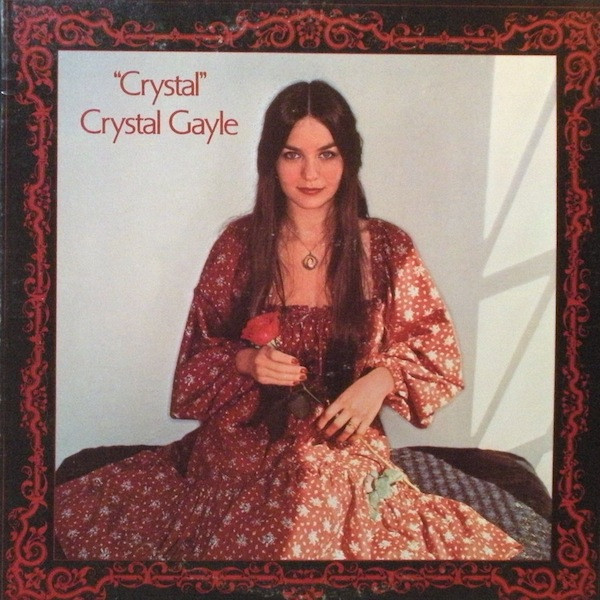
Crystal increased in popularity steadily from 1970 to 1976 likely due to the growing success of country music singer and sex symbol Crystal Gayle. Her first single in 1970 influenced the name in the southern states initially and by 1976, the year of her first widely successful album titled Crystal, the name Crystal was already a top 10 girl's name in several states (West Virginia, North Carolina and South Carolina) and top 20 in others (Virginia, Tennessee, Arkansas, Oklahoma, Kentucky). 
Crystal Gayle on the cover of her 1976 album Crystal. Source

The character that pushed it over the top in the rest of the US though was Linda Evan's portrayal of Krystle Carrington in the soap opera Dynasty, which ran from 1981 to 1989. Krystle was the former secretary and now sweet and caring second wife of Blake Carrington, the moral opposite of his ex-wife Alexis, played by Joan Collins. It is interesting that at this point the popularity of Crystal started to stall or decrease in the states where it was already popular. This suggests either it became considered too mainstream in those states, or that the Krystle character did not match up with how the name was viewed, initially associated with the fiery home town country singer Crystal Gayle. The character might have endeared the name to some parts of America, while spoiling it for others.
Linda Evans as Krystle Carrington on the soap opera Dynasty. Source

Looking at the characters given the name Crystal up until this point, they all have an element of an ambitious woman from less privileged backgrounds. Sometimes she's clever, sometimes kind, but usually she's using her sexual attractiveness to her advantage. Whether you thought that was something to be admired or treated with contempt probably predicted whether you liked the name enough to give it to your daughter.

It was in the late 1980s when the term "crystal meth" started becoming known more widely as slang for crystal methamphetamines and I wonder if that hastened the decline in popularity of Crystal. The Krystal spelling got a small bump in popularity in 1985, perhaps due to the singer Krystal Davis who had a hit song "So Smooth". In 1995 the movie Showgirls had a stripper named Cristal played by Gina Gershon. 

Initially when I saw how the name was popular in states lowest on the American socio-economic spectrum, it seemed obvious why it would have a low class connotation. In 1995 when the writers named the Showgirls stripper Cristal, the majority of American Crystals of all spellings would have been under 25 years old and the name was already dropping quickly in the popularity charts. It seems a bit too soon for all the real world Crystals to have had a chance to influence the associations with the name, they seem to have been doomed from the very start no matter what profession they chose as adults.

End Note: After researching this name, I am a little disappointed that the soap opera character Krystle gets all the credit for the popularity of Crystal on the Wikipedia page. I would give Crystal Gayle a lot more credit, especially in the south. She was inspired to chose her stage name by the southern fast food chain Krystal and for the association with bright and shiny stones. The restaurant chose its name during the depression to inspire cleanliness. The terms 'crystal clean' appears to have had 19th century Christian religious associations, but that's a rabbit hole for another day.

Sources: Nancy.cc "What gave the baby name Krystal a boost in 1951?" , Wikipedia: Crystal Gayle , Wikipedia: Crystal (name)

Saturday, March 19, 2022

The Popular History of the Name Shelby in the US

 After making the Jackson graph that had so many possible influences, I thought I'd graph a trendy name for contrast. Shelby was an uncommon surname used as a first name in the US, mainly for boys but occasionally for girls.  There were three big influences on the name: Barbara Stanwyck playing Shelby Barrett in 1935, Julia Roberts as Shelby Eastenton-Latcherie in 1989, and Lt. Commander Shelby in 1990. It was interesting to see that the first peak in popularity for girls did not throw parents off giving it to boys, and that the second peak in 1989 actually created an increase in usage for boys. The eventual overwhelming popularity for girls does seem to have discouraged more parents from using it for their boys, especially after it appeared as the name of a female young teen on a show aimed at teenagers in The Mystery Files of Shelby Woo. 

Thursday, March 17, 2022

The Many Faces of Jackson in US Media

 What makes a name popular? Jackson peaked in popularity in the US in 2013 but if you combine spelling varieties (Jaxon, Jaxson) it was the number one boy’s name from 2014 to 2020. I’ve mapped the appearance of notable characters in entertainment that were named Jackson to the popularity of the name (converted to % of boys named by year). 


The key ingredient for name popularity seems to be variety. Jackson doesn’t get pigeonholed into just one type of character. He’s a suave lawyer or doctor, or a dorky scientist, a tortured artist, a goofy farmer, a privileged heir, a dangerous criminal, or biker gang member. The artsy parents pick it for the artist association, the cool parents pick it for biker association, and the preppy parents pick it for the doctor association. Parents looking for the nickname Jax popularized by the Sons of Anarchy character are driving the Jaxon and Jaxson spellings.

Some notes: I have never watched Stargate but I have read that the character Dr. Daniel Jackson gets referred to on the show as Jackson enough that the association with the character is there. First name position usually has a bigger influence than last name, but in this case I think it was worth mentioning. 

Also, I wasn’t convinced the movie Luster had much impact in 2002, but there was a spike in popularity that year, so I checked celebrity babies. Carson Daly and Siri Spinter, Brent Spiner and Loree McBride, and Maria Bello and Dan McDermott (Jackson Blue!) all named sons Jackson during that period.

If there is an influence that should be included, feel free to leave a comment.

Thursday, March 10, 2022

The Popular History of the Name Hayden in the US

Hayden is another surname that has been transferred over into first name usage in the US and Canada. This graphic follows the influences on its popularity. Missing from this graphic (because I ran out of room) is the female character Hayden Chase who first appeared on the show Alias in 2005. Let me know if you think there is another influence I may be missing.


A Tale of Two Sidneys

Sidney was a common boys’ name for those born in the early 20th century and was among the first surnames to become widely used as given name...