Wednesday, January 11, 2023

Why are people naming boys Artemis?

If you are only familiar with Artemis as a Greek goddess it can be hard to understand how it can be seen as a name for boys. Artemis Fowl gets blamed for making Artemis sound masculine but he wasn't the first.

There was Artemis the male cat in Sailor Moon, Artemis Gordon in the movie Wild Wild West, and Artemis Entreri, an assassin in the Forgotten Realms franchise. For me, that is too many to be just a coincidence. Is there a historical precedent?

You do find a few older American graves on findagrave.com for men named Artemis mixed in with the women. Occasionally their names will also get spelled Artemas or Artemus.

Artemas is a biblical name. In the letters to Titus, Paul mentions him as one of his disciples. The etymology is often interpreted as a version of the Greek name Artemidoros which means "gift of Artemis". One of the early American Revolutionary War heros was named Artemas Ward.

Artemus is a form of the Latin name Artemius, from the Greek Artemios meaning "devoted to Artemis". Saint Artemius was martyred in the 4th century and he is considered a Saint in the Catholic and Eastern Orthodox Christian churches.

You can imagine how Artemas, Artemus, and Artemis might get mixed up in English. They are obviously related but their usage as first names was too rare to establish an awareness of the difference. That's less likely to happen with common names like Jessie and Jesse but even with a popular name they get confused for the same name. Someone unfamiliar with Artemus might have also "corrected" the spelling to the more familiar Artemis.

Does that mean there are a bunch of men named Artemis in the US? No, not according to the SSA name database. No more than 16 are recorded before 2000, with double that many probably missed by the privacy cut off of 5. In the mean time, Artemis for girls was pretty rare as well, with about 300 women named between 1930 and 2000. If you add in men named Artemas and Artemus, the ratio is closer to 2:1 male to female. The Artemis Gordon in the 1960s tv show The Wild Wild West (and the 1980 tv movie AND the 1999 Will Smith movie) was in truth an Artemus, probably inspired by the previously mentioned Artemas Ward. The appearance of boys named Artemis in the data lines up with the Wild Wild West productions so I'm guessing the mix up started there.

That's the American context, but what about the Greek context? In Greece, there are two uncommon names that get transliterated as Artemis into English: Άρτεμις which is feminine and Αρτέμης which is masculine. They both are pronounced the same, Artemis, but have a different syllable emphasized which is lost in translation. AR-te-mis vs ar-TE-mis. Their usage is due to that same Saint Artemios, but are shortened forms. You'll also find Artemio in Italian or Spanish, Artjoms in Latvia, Артём (Artyom) in Russia and Артем (Artem) in Ukraine.

Artyom and Artem are particularly popular in Russia and Ukraine (currently top 10) due to veneration of the 16th century child saint Арте́мий Ве́ркольский (Artemyy of Verkola). (Fun fact, his mother was named Apollinariya which is another saint name derived from a Greek god. Apollo is the twin of Artemis.)

So whether you mishear Artemus as Artemis, or run into a Greek man named Artemis, there is a chance a modern person might know a man named Artemis. This, and all the other previous male usage, might have led the author of Artemis Fowl to assume it was a well known unisex name. I think Eoin Colfer was a little surprised with how much confusion the name choice caused, which he addressed in the 3rd book.

So yes, Artemis is a female goddess from Greek mythology, but as a name for a real person it has a lot of history as a masculine name too, or at least, history of being mistaken for a similar male name. We probably just reached a tipping point with Artemis Fowl. Artemis is now trending as both a girl's and a boy's name in the US. This happens so rarely for feminine names that it's kind of amazing. Usually this story is about how a masculine name started getting used for girls.

Addendum: In 1997, an episode of Seinfeld had this exchange between Jerry and George, discussing who the last American president with a beard was:

George Costanza: Artemis N. Falkmore.

Jerry Seinfeld: You made that up, right?

George Costanza: Yeah. But it sounds like a president name, doesn't it?

According to one of the most popular American sitcoms, Artemis sounds like an old fashioned man's name.

Sunday, April 24, 2022

Words from Men's Type Names

A type name is an eponym that comes from a given name that is used frequently by a generalized group of people. The most popular one at the moment is a Karen, used to describe a middle aged entitled woman. Most type names fade and lose their associations but some of them have stuck around. They evolved into words we still use today. Here are a couple that come from men’s given names or nicknames.

Hick – One of the many medieval short forms of Richard in England was Hick or Hikke. Often the leading R would get changed to an “H” as in Hob for Robert or Hodge for Rodger. Richard was a very popular name and Hick came to be used as a general name for any hosteler (innkeeper) or hackneyman (hires out coaches or horses). By the 1700 it had become a name that describes an awkward provincial person, and then by 1900 was being used as an adjective, as in “hick town” for a rural town.

Rube – After the Protestant Reformation in England, Old Testament names started to become popular as an alternative to New Testament and Saint names which were perceived to be too Catholic. Reuben was popular and was shortened to Reub or Rube. By 1804 it was being used as a type name to refer to a farmer, rustic or country bumpkin.

Zany – The Venetian diminutive of Giovanni (the Italian form of John) was Zanni and was used as the name of a buffoon character in comedic plays. The Zanni would mimic the actions of the principal in an exaggerated way. It was also used as the name of any unnamed character that wasn’t one of the main comedic characters. It was basically the Italian version of Jack. One of Zanni’s other traits was carrying around the props of the other characters, so another more archaic meaning for a zany is a toady or servile follower. This is probably closer to the meaning Shakespeare meant in the play Love’s Labour’s Lost.

Jacket - In medieval France, Jacques was used as a type name for a French peasant, from the French form of the Greek Iocubus, the same root as the English Jacob and James. Jaques or Jakke was then used to describe a type of tunic that was short and quilted for defense. The word existed in England in the 14th century and jacket is likely a diminutive of this to describe a short coat with sleeves for men by mid 15th century.

Yankee – In the 17th century there were a lot of Dutch colonists in New Amsterdam (now New York) and they referred to those rotten Englishmen over in Connecticut as Yankees, possibly from Janke or Janneke, the diminutive of Jan, the Dutch version of John. Or it was the English who were using it to refer to those lazy Dutch colonists. Either way it has been used derogatively and reclaimed a couple times, notably in the song Yankee Doodle, written by the English to make fun of the Americans during the American Revolutionary War, and adopted by Connecticut as the state’s official song.

Jockey – Jock is the Scottish variant of the name John, and the diminutive Jockey was used to refer to any person or fellow in the 16th century, like Johnny. It then became used to refer to a person who rides horses in races by the mid 17th century. The verb ‘to jockey’ which means to trick, outwit or gain advantage comes from the related profession of horse trading. A jock, an athletic man, comes from the word jockstrap, “athletic support”, but jock in this sense is used as slang for penis, like the English “dick”.  

There is a whole list of words that stem from the name Jack being used as a type name, but those are clearly connected to the name and less obscure. Others which were also used as type names before they were used for tools are billie (club) and jimmy (pry). I made a list of Words from Women's Type Names as well.

Source: etymonline.com

Friday, April 15, 2022

American Media Influences on the name Crystal

Crystal has been around as a woman's name since the 19th century in the US. It was given to between 80 and 120 girls a year up until the 1940s. It rose very quickly in popularity in the 1970s and I was very surprised to find that it broke into the top 10 girls names (#9) in 1982. I'll be honest, and I apologize to anyone who may have this name, but it has always sounded like a stripper's stage name to me. Since I don't frequent strip clubs, this association must have been shaped by television and movies. I went on the hunt for the reasons of this impression. 

The first bump in the name's popularity was likely due to Joan Crawford's portrayal of seductive perfume counter girl Crystal Allan in the 1939 film The Women (It's all about Men), a popular all-female cast film based on a 1936 play by Clare Booth Luce. She is the mistress who eventually marries the antagonist's ex-husband. Then in 1946 scream queen Evelyn Ankers plays a stripper named Crystal McCoy in the murder mystery Queen of Burlesque. Only two references in and I've already found a stripper named Crystal. The name was also used for one of the main characters in the film noir drama Three Strangers that same year. Geraldine Fitzgerald played Crystal Shackleford, a woman who lures two strangers to stand before a strange Chinese idol to make a wish. The name did get a small boost that year but neither character endeared the name to many people. It was also the first year the Krystal spelling appeared in the data given to at least 5 girls. 

Joan Crawford as Crystal Allan in The Women. Source

In 1951, Crystal might have gotten increased usage in and around Michigan due to a set of quadruplets born to the Rosebush family of Oakwood, Michigan, one of who was named Krystal. This won't be the last time alternative spellings of Crystal influence the name. In 1957 the role of Crystal Allan was played by Joan Collins in a remake of the 1939 movie called The Opposite Sex, although this version included men in the cast. There was a small increase in 1963 which I can only attribute to Barbara Eden's character Crystal Simpson in an episode of Rawhide. She is a conman's assistant who performs a harem dance to distract the crew, and was notably performed before Eden was cast as Jeannie in I Dream of Jeannie. 

Barbara Eden as Crystal Simpson in a 1963 episode of Rawhide. Source
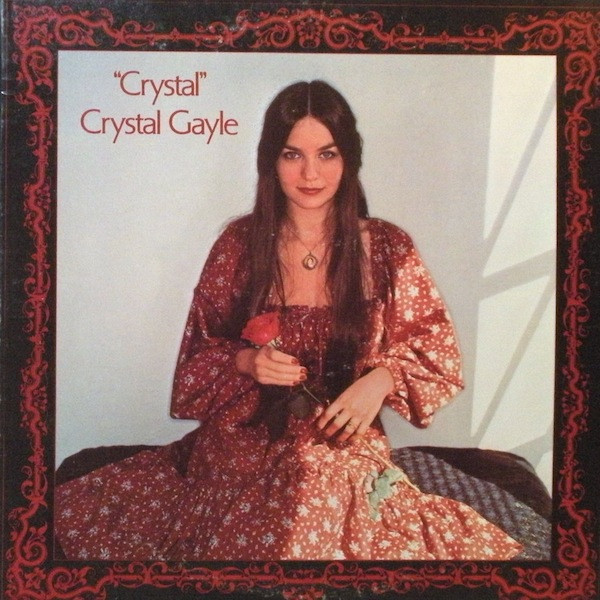
Crystal increased in popularity steadily from 1970 to 1976 likely due to the growing success of country music singer and sex symbol Crystal Gayle. Her first single in 1970 influenced the name in the southern states initially and by 1976, the year of her first widely successful album titled Crystal, the name Crystal was already a top 10 girl's name in several states (West Virginia, North Carolina and South Carolina) and top 20 in others (Virginia, Tennessee, Arkansas, Oklahoma, Kentucky). 
Crystal Gayle on the cover of her 1976 album Crystal. Source

The character that pushed it over the top in the rest of the US though was Linda Evan's portrayal of Krystle Carrington in the soap opera Dynasty, which ran from 1981 to 1989. Krystle was the former secretary and now sweet and caring second wife of Blake Carrington, the moral opposite of his ex-wife Alexis, played by Joan Collins. It is interesting that at this point the popularity of Crystal started to stall or decrease in the states where it was already popular. This suggests either it became considered too mainstream in those states, or that the Krystle character did not match up with how the name was viewed, initially associated with the fiery home town country singer Crystal Gayle. The character might have endeared the name to some parts of America, while spoiling it for others.
Linda Evans as Krystle Carrington on the soap opera Dynasty. Source

Looking at the characters given the name Crystal up until this point, they all have an element of an ambitious woman from less privileged backgrounds. Sometimes she's clever, sometimes kind, but usually she's using her sexual attractiveness to her advantage. Whether you thought that was something to be admired or treated with contempt probably predicted whether you liked the name enough to give it to your daughter.

It was in the late 1980s when the term "crystal meth" started becoming known more widely as slang for crystal methamphetamines and I wonder if that hastened the decline in popularity of Crystal. The Krystal spelling got a small bump in popularity in 1985, perhaps due to the singer Krystal Davis who had a hit song "So Smooth". In 1995 the movie Showgirls had a stripper named Cristal played by Gina Gershon. 

Initially when I saw how the name was popular in states lowest on the American socio-economic spectrum, it seemed obvious why it would have a low class connotation. In 1995 when the writers named the Showgirls stripper Cristal, the majority of American Crystals of all spellings would have been under 25 years old and the name was already dropping quickly in the popularity charts. It seems a bit too soon for all the real world Crystals to have had a chance to influence the associations with the name, they seem to have been doomed from the very start no matter what profession they chose as adults.

End Note: After researching this name, I am a little disappointed that the soap opera character Krystle gets all the credit for the popularity of Crystal on the Wikipedia page. I would give Crystal Gayle a lot more credit, especially in the south. She was inspired to chose her stage name by the southern fast food chain Krystal and for the association with bright and shiny stones. The restaurant chose its name during the depression to inspire cleanliness. The terms 'crystal clean' appears to have had 19th century Christian religious associations, but that's a rabbit hole for another day.

Sources: Nancy.cc "What gave the baby name Krystal a boost in 1951?" , Wikipedia: Crystal Gayle , Wikipedia: Crystal (name)

Saturday, March 19, 2022

The Popular History of the Name Shelby in the US

 After making the Jackson graph that had so many possible influences, I thought I'd graph a trendy name for contrast. Shelby was an uncommon surname used as a first name in the US, mainly for boys but occasionally for girls.  There were three big influences on the name: Barbara Stanwyck playing Shelby Barrett in 1935, Julia Roberts as Shelby Eastenton-Latcherie in 1989, and Lt. Commander Shelby in 1990. It was interesting to see that the first peak in popularity for girls did not throw parents off giving it to boys, and that the second peak in 1989 actually created an increase in usage for boys. The eventual overwhelming popularity for girls does seem to have discouraged more parents from using it for their boys, especially after it appeared as the name of a female young teen on a show aimed at teenagers in The Mystery Files of Shelby Woo

Thursday, March 17, 2022

The Many Faces of Jackson in US Media

 What makes a name popular? Jackson peaked in popularity in the US in 2013 but if you combine spelling varieties (Jaxon, Jaxson) it was the number one boy’s name from 2014 to 2020. I’ve mapped the appearance of notable characters in entertainment that were named Jackson to the popularity of the name (converted to % of boys named by year). 


The key ingredient for name popularity seems to be variety. Jackson doesn’t get pigeonholed into just one type of character. He’s a suave lawyer or doctor, or a dorky scientist, a tortured artist, a goofy farmer, a privileged heir, a dangerous criminal, or biker gang member. The artsy parents pick it for the artist association, the cool parents pick it for biker association, and the preppy parents pick it for the doctor association. Parents looking for the nickname Jax popularized by the Sons of Anarchy character are driving the Jaxon and Jaxson spellings.

Some notes: I have never watched Stargate but I have read that the character Dr. Daniel Jackson gets referred to on the show as Jackson enough that the association with the character is there. First name position usually has a bigger influence than last name, but in this case I think it was worth mentioning. 

Also, I wasn’t convinced the movie Luster had much impact in 2002, but there was a spike in popularity that year, so I checked celebrity babies. Carson Daly and Siri Spinter, Brent Spiner and Loree McBride, and Maria Bello and Dan McDermott (Jackson Blue!) all named sons Jackson during that period.

If there is an influence that should be included, feel free to leave a comment.

Thursday, March 10, 2022

The Popular History of the Name Hayden in the US

Hayden is another surname that has been transferred over into first name usage in the US and Canada. This graphic follows the influences on its popularity. Missing from this graphic (because I ran out of room) is the female character Hayden Chase who first appeared on the show Alias in 2005. Let me know if you think there is another influence I may be missing.


The History of the name Kimberly

 In my search for examples of feminine names that have switched over to masculine names, I came across Kimberly.

The story starts way back with the Old English woman's name Cyneburg, which means “royal fortress”. St. Cyneburg was the daughter of 7th century King Penda, and she was the founder of an abbey in Northhamptonshire called Cyneburgecaestre (it’s now called Castor). Kimberley appears in the 1086 Doomsday book as a location name Chineburlai, meaning woodland clearing of the royal fortress. It became the location surname of residents of the area. Cyneburg did also carry on as a woman’s name in forms such as Kingburgh or Kinborough, and Kimbery through to the 17th century.

Skip ahead to 1890, John Wodehouse, 1st Earl of Kimberley lends his name to the mining town of Kimberley, North Cape, South Africa. A bit of a malicious compliance story on how they chose the name: “… John Wodehouse, 1st Earl of Kimberley, insisted that before electoral divisions could be defined, the places had to receive decent and intelligible names. His Lordship declined to be in any way connected with such a vulgarism as New Rush and as for the Dutch name, Vooruitzigt … he could neither spell nor pronounce it. The Colonial Secretary tasked with the job made quite sure that Lord Kimberley would be able both to spell and pronounce the name of the main electoral division by, as he says, calling it 'after His Lordship'. New Rush became Kimberley, by Proclamation dated 5 July 1873.”

The mining town was the site of the Siege of Kimberley in 1899 during the Boer War. It started to be given to boys and a few girls as either a famous battle name, or to commemorate a relative who died there. It was still pretty rare in the UK, about 30 boys and 10 girls were named Kimberley in the 10 years after the battle. About another 400 boys and girls were given it as a middle name.

This is where I have to explain the popularity of a completely different name: Kim. In the US, Kim was used as a short name for Kimball, an uncommon surname as first name used mainly by men in the US during the 19th century. In 1850, 245 Kimballs lived in the US. Kim itself started to get used rarely for boys after Rudyard Kipling’s book Kim was published in 1901. In that book, the boy is named Kim short for Kimball. For Kim in the UK, I didn’t find many examples and where I did, they were in Ireland and Scotland. Kim is also a man’s name in Scandinavian countries, short for Joachim.

There were both men and women with the first name Kim in the SSA database after 1900 but it started getting popular for girls after it appeared in Edna Ferber's 1926 novel Show Boat, where the protagonist names her daughter Kim after the first three letters of the American states: Kentucky, Illinois, and Missouri. It was a very rare unisex name until Kim took off for boys after the 1950 film adaption of the Kipling book, which starred Errol Flynn. There was also a character called Kim Parker, a female reporter in the 1949 Ma and Pa Kettle movie series. It got way more popular for girls in the late 50s, probably due to the influence of actresses Kim Hunter and Kim Novak, who both chose it as a stage name. Kim Hunter was in the 1951 movie A Streetcar Named Desire and Kim Novak was in Vertigo in 1958. Following right behind it was the name Kimberly. I didn’t find a reason why Kimberly took over. I am guessing it was considered the longer, formal form of Kim, despite Kim getting popular first (it peaked at #34 for girls and #98 for boys).

Kimberly was very popular for girls in the late 60s in the US and occasionally given to boys. It peaked for both at the same time although for boys it only reached #552. It peaked for girls in 1967 at #2 and has remained relatively popular ever since with a slow decline (It still ranks #184 in 2020). In the UK, New Zealand and Australia, the Kimberley spelling was more popular and shot up in popularity only in 1981, I’m guessing because of singer Kim Wilde (who was also just Kim, born in 1960 at the peak of Kim in the UK, so again more parents chose the ‘long form’ of a trending name). In Australia you are more likely to run into a Kim-just-Kim than a Kimberley, although the Kims will be older than the Kimberleys.

So although Kim could be seen as masculine short name that became feminine, Kimberly/Kimberley does appear to have feminine roots and to have at least been considered unisex since the beginning of its popular usage as a first name. Not quite a girl name on a boy, but also not a case of a boy name “going to the girls”.

Friday, February 11, 2022

Words From Women's Type Names

A type name is a personal name used to describe a type of person who is most likely to have the name, like Karen is used to describe a middle aged woman who might feel a little too entitled. These are different from eponyms as they aren't used in reference to one person with the name, but to all people with the name. I've collected these words as historical examples of when a popular woman's name or nickname was used to describe a type of person, which then evolved into a new word.

St. Tib's Eve

Tib is an old nickname for Isabel, popular in Europe during the Middle ages, and often paired with Tom in the same way Jack is paired with Jill. Tib came to mean prostitute in the 1500s, and spawned the phrase "on St. Tib's eve", meaning something very unlikely to happen similar to "when hell freezes over", because a prostitute would never be made a saint. (St. Tib's Eve is celebrated in Newfoundland on Dec 23rd, because Newfies).

Jilt

Jill is a short form for Jillian or Gillian, the Middle English common form of Juliana. It was very popular in medieval England, and became a generic term for a girl in the early 1400s, and paired with Jack since mid 1400s. Gillet (or Jillet) was another diminutive that came from Jillian, and became a familiar or contemptuous name for a woman or girl. Jilt is probably from the contraction of jillet/gillet, and came to mean a loose, unchaste woman, or harlot from 1670s. From this you get the verb "to jilt", as in jilted lover, to mean give hope then discard.

Merkin

Malkyn was a diminutive of the name Maud/Mault (itself a shortened form of Matilda) or Mary during the Middle ages. It came to mean a woman of lower class, a slattern, or loose woman by the 1200s. From Malkyn came malkin which was used to refer to a mop, possibly from the sense of "untidy woman", or a bundle of rags. From the mop meaning you get merkin as the name of a wig for pubic hair used by prostitutes, attested to at least 1610s, which is still used today. Also related is grimalkin, the name of the witch's cat from Macbeth, from grey-malkyn where Malkyn was used a name for a female cat in the same way Tom is used for males.

Mollycoddle

The female proper name Molly or Moll served as a type name of a low-class girl or prostitute in old songs and ballads (perhaps in part for the sake of the easy rhymes) from the 1600s. Both are familiar forms of Mary. By the 1700s, molly was a colloquial term for a homosexual or effeminate male, and from that we get mollycoddle, which means to pamper or fuss over.

Biddy

From an Irish nickname for the very popular Brigid, used to refer to any Irish serving maid, and also a complaining old woman.

Floozie

From 1700s canting slang which used the name Florence to mean a well dressed wench, "touz'd and ruffled". The word flossy then appeared which in the 1890s was slang for fancy or frilly, and by 1902 floozie meant a woman of disreputable character.

Men's names have similar examples with Jack doing the lions share of the work in word creation. Examples include jacket, jockey, and hijack but there's also billy, jimmy, zany and yankee.

(Source: etymoline.com)

Tuesday, February 1, 2022

Three Surprising Unisex names from the Early 20th century, USA

Cleo, June and Fay were at one time unisex names. Let's start with Cleo.

Cleo can be short for Cleopatra but it was also short for Cleon and the biblical name Cleopas. Cleon is from the Greek word for glory. Cleopas comes from the same root as Cleopatra, it is a short form of the masculine version Cleopatros. In the Gospel of Luke, Cleopas sees Jesus after his resurrection. Cleo for men is recorded more often in the SSA dataset than both Cleopas and Cleon. Cleo was still twice as popular for women in the 1920s, although women are over represented in the early data.

June can be short for Junius, a masculine name that had some use in the American south during the 1800s. The father of J.P. Morgan and the father of John Wilkes Booth were both named Junius, likely in honour of the anonymous author of the British Junius papers in which Junius was his pseudonym. June can also be found being used by women but widespread popular use only occurred in the late 19th century. June can also be short for Junior. A notable man with the name was June C. Smith, Illinois Supreme Court Judge.

And last but not least, as it is my favourite, is Fay. Fay is short for Lafayette, a popular man's name in the US in the 1800s, given in honour of American Revolutionary War commander Gilbert du Motier, Marquis de Lafayette. Fayette, Lafe, and Fate are other short forms but Fay was the most popular at the turn of the century. Fay and Faye became more popular for women in the 1910s and '20s but Fay did still have some usage by men. Notable men include American sprinter Fay Moulton, baseball player Fay Thomas, and architect E. Fay Jones, a student of Frank Lloyd Wright, and for whom the Fay Jones School of Architecture and Design is named at the University of Arkansas.

A Tale of Two Sidneys

Sidney was a common boys’ name for those born in the early 20th century and was among the first surnames to become widely used as given name...